

Studies & Analysis | SciKeys Association Publications
Electricity as a Prerequisite for Reconstruction: Challenges of the Syrian Power System and Technically Feasible Solutions
Prepared by: Wissam Al-Sheikh | Published: 2026/05/23
For the latest version and interactive references, visit: https://scikeys.org/en/syrian-power-system-reconstruction/

Electricity as a Prerequisite for Reconstruction: Challenges of the Syrian Power System and Technically Feasible Solutions
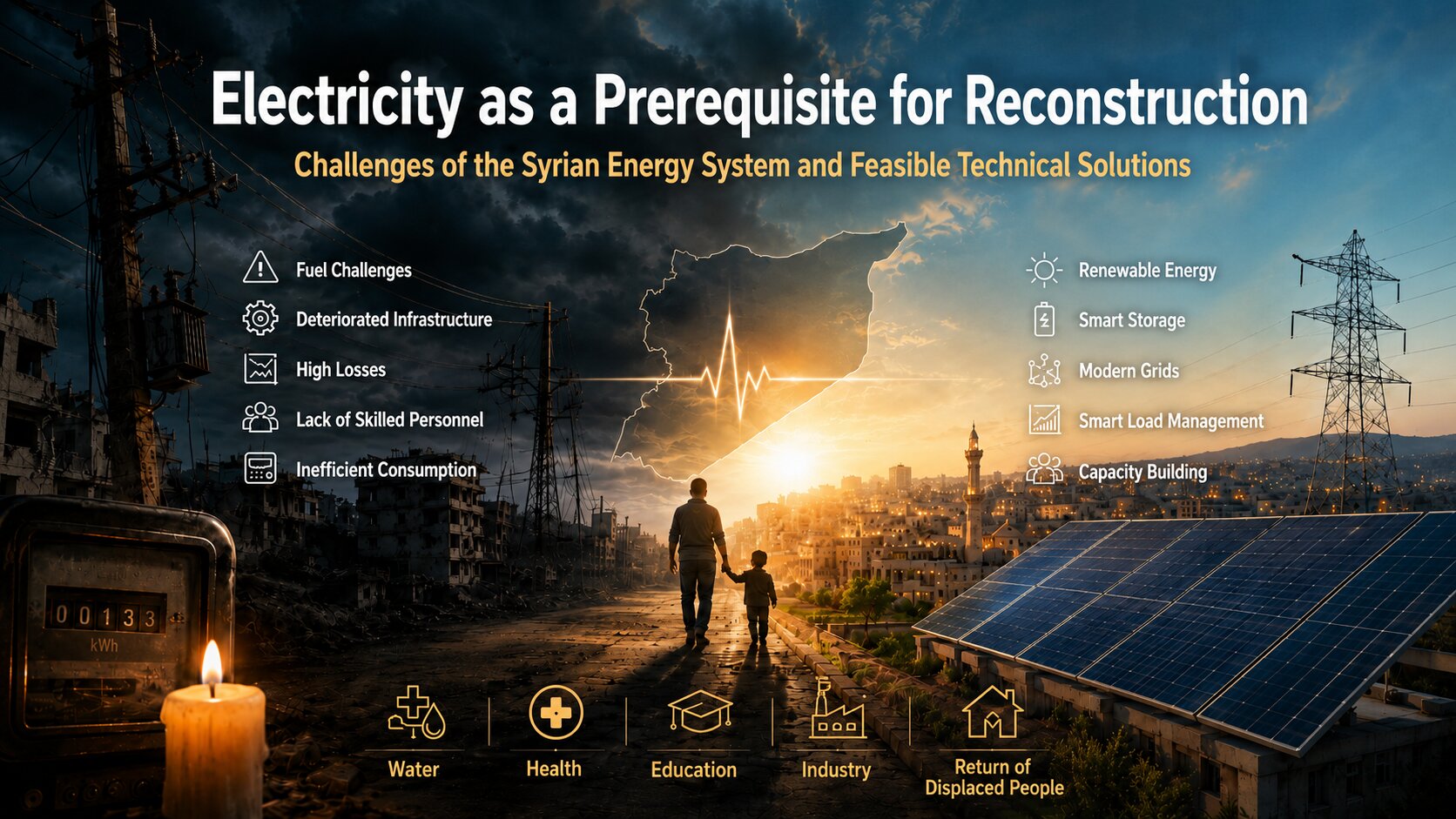
The Syrian power system is not merely a provider of household electricity; it is a foundational infrastructure required for operating water supply, healthcare, education, industry, and agriculture. Therefore, the rehabilitation of Syria’s electricity sector must be regarded as a central entry point for any realistic reconstruction pathway.
Introduction to the Problem
Syria’s electricity crisis cannot be reduced solely to a shortage of generation capacity or fuel. The crisis is systemic in nature and includes fuel supply, power plants, transmission and transformation networks, distribution grids, losses, consumption efficiency, technical personnel, and operational governance.
Consequently, real improvement cannot be achieved only by building new power plants. Instead, it requires an integrated package of measures that increase the availability of existing units, reduce losses, improve demand-side efficiency, regulate the expansion of solar energy, and rebuild the technical and institutional capacity of the sector.
Core Idea
- Electricity is a prerequisite for operating essential services.
- Reducing losses can be equivalent to adding new generation capacity.
- Demand management is part of the solution, not a secondary measure.
- Solar energy is necessary, but it requires technical regulation.
- Training and data are no less important than equipment.
Diagnosis of Syria’s Electricity Crisis
⛽ Fuel as a Governing Constraint
Syria’s power generation system depends heavily on fossil fuels, particularly natural gas. Therefore, the technical availability of a power plant is insufficient if fuel is not available in a stable and reliable manner.
⚙️ Declining Generation Availability
Power plants suffer from insufficient maintenance, aging equipment, limited spare parts, and fluctuating fuel quality, all of which reduce the actually available capacity.
🔌 Weak Transmission and Transformation Infrastructure
Increasing generation capacity is not sufficient if transmission lines and substations are unable to deliver electricity to demand centers in a stable and secure manner.
📉 Technical and Non-Technical Losses
Electricity losses lead to wasted energy and financial resources. Every kilowatt-hour saved by reducing losses is equivalent to additional energy delivered to consumers without requiring new fuel.
👷 Shortage of Technical Personnel
A damaged electrical system cannot be operated without technicians trained in protection systems, transformers, distribution networks, solar energy, batteries, and power quality.
🏠 Low Consumption Efficiency
The crisis is not limited to the supply side but also includes demand. Old appliances, thermal loads, and inefficient consumption behavior increase pressure on the grid.
The Deteriorated Condition of the Grid Directly Affects Electricity Supply
Syria’s current electricity demand required to fully cover domestic consumption is estimated at around 7,000 MW, while the actual generation available on the grid often ranges between 1,600 and 2,200 MW, depending on the source, time, and method of measurement.
The problem does not lie only in the number of installed power plants, but in the gap between nominal capacity, available capacity, and actually generated power. Before 2011, installed capacity was approximately 9.5 GW, while generation in 2025 declined to around 1.6 GW according to some estimates.
Power Balance Equation
The power balance shows that alleviating the electricity crisis cannot be achieved only by increasing generation, but also by reducing losses, improving storage, managing demand, and developing regional interconnections.
Unserved power represents the core of load shedding, while losses represent part of the energy that is generated or transmitted without reaching final use. Therefore, reducing losses and managing demand have a direct impact on supply hours.
Where Should the Solutions Begin?
🚑 Phase One: 0–6 Months
- Rapid maintenance of existing units with the highest impact.
- Fuel allocation based on efficiency, availability, and grid impact.
- Provision of hybrid systems for hospitals, water pumping stations, and bakeries.
- Management of critical loads according to transparent and reviewable priorities.
- Rapid technical training in distribution, protection systems, and solar energy.
📊 Phase Two: 6–24 Months
- Measurement of losses at feeder level and gradual mitigation.
- Rehabilitation of bottlenecks in transmission and transformation infrastructure.
- Implementation of simplified monitoring systems for loads, faults, and power quality.
- Launch of a national program for household appliance efficiency.
- Adoption of a fair block tariff that protects basic consumption.
🌱 Phase Three: 2–5 Years
- Connection of solar farms to strong and well-studied grid nodes.
- Gradual and carefully planned integration of electrical storage.
- Modernization of protection systems and black-start restoration plans.
- Development of regional interconnections after strengthening the internal grid.
- Establishment of a professional certification system for electricity and solar technicians.
Decentralized Solar Energy: A Necessary Solution That Requires Regulation
Weak public electricity supply has led to the spread of residential and commercial solar systems. This expansion represents a natural response to the electricity crisis, but it may create technical challenges if it occurs without regulation, particularly in low-voltage networks.
Uncontrolled solar feed-in can cause local voltage rises, reverse power flow, phase imbalance, and protection-related problems. Therefore, encouraging the installation of solar panels is not sufficient. Grid connection standards for inverters, voltage and frequency limits, and feeder hosting-capacity studies must also be established.
Priority Project Selection Matrix
| Criterion | Evaluation Question | Application Example |
|---|---|---|
| Service impact | How many additional supply hours can be achieved? | Repairing a feeder supplying a water pumping station |
| Implementation speed | Can the project be completed within months? | Supplying circuit breakers and protection relays |
| Fuel sensitivity | Does the project require continuous fuel supply? | Loss reduction is less fuel-sensitive than a thermal power plant |
| Grid readiness | Can the generated electricity be transmitted? | Connecting a solar plant near a strong substation |
| Social impact | Does it improve service for the most vulnerable groups? | Supplying water infrastructure, bakeries, and health centers |
| Measurability | Can the impact be measured after implementation? | Measuring feeder losses before and after intervention |
Logic of Investment Decision-Making
The best project is not always the cheapest or the largest, but the project that reduces outages, losses, and risks with the highest possible social and economic impact. This can be summarized using a multi-criteria objective function:
This formulation highlights the importance of energy not supplied, investment cost, losses, fuel cost, and risks related to implementation, sabotage, or insufficient maintenance. Accordingly, electricity-sector decision-making becomes a technical, social, and economic decision at the same time.
Practical Recommendations
- Launch a rapid 100- to 200-day maintenance program targeting the units, substations, and feeders with the highest impact.
- Implement a feeder-level loss reduction program, starting with measurement and then expanding based on the results.
- Prioritize the rehabilitation of transmission lines and substations that remove major bottlenecks.
- Regulate solar expansion through clear grid connection standards and hosting-capacity studies.
- Establish training centers for electricity, solar energy, and battery technicians.
- Launch a national appliance efficiency program, particularly for high-consumption thermal loads.
- Adopt a fair block tariff that protects basic consumption and limits excessive consumption.
- Establish a data room for the electricity sector covering assets, faults, losses, and supply hours.
- Link any new funding to measurable impact indicators, such as reducing unserved energy and lowering losses.
- Treat electricity as a foundational infrastructure for reconstruction, not as an isolated service sector.
Conclusion
Every megawatt saved through efficiency and loss reduction is, from the perspective of the power system, equivalent to a new megawatt that requires neither fuel, nor a power plant, nor an additional transmission line. Therefore, the reform of Syria’s electricity sector must begin with a balanced equation: more energy, lower losses, more efficient demand, and stronger technical capacity.
References
[1] United Nations Development Programme, “Accelerating economic recovery is critical for reversing Syria’s decline and restoring stability,” 2025.
https://www.undp.org/syria/press-releases/accelerating-economic-recovery-critical-reversing-syrias-decline-and-restoring-stability
[2] World Bank, “Syria: World Bank US$146 Million Grant to Improve Electricity Supply and Support Sector Development,” 2025.
https://www.worldbank.org/en/news/press-release/2025/06/25/syria-world-bank-us-146-million-grant-to-improve-electricity-supply-and-support-sector-development
[3] World Bank, “Syria Electricity Emergency Project,” Project Documents, 2025.
https://documents1.worldbank.org/curated/en/099060625055567160/pdf/P511407-afa010d5-6fc0-4c0d-859d-79b01a31c3f5.pdf
[4] International Energy Agency, “Syria: Electricity,” 2023 data.
https://www.iea.org/countries/syria/electricity
[5] Reuters, “Nationwide power outage in Syria due to malfunctions, energy ministry says,” April 2025.
https://www.reuters.com/world/middle-east/nationwide-power-outage-syria-due-malfunctions-energy-ministers-spokesperson-2025-04-01/
[6] Reuters, “Syria signs $7 billion power deal with Qatar’s UCC Holding-led consortium,” May 2025.
https://www.reuters.com/business/energy/syria-signs-7-billion-power-deal-with-qatars-ucc-holding-consortium-2025-05-29/
[7] High losses and deteriorated infrastructure: strategic plans to rebuild Syria’s electricity system.
https://sana.sy/economy/2318116/
Editorial Note:
This article is published as an analytical contribution under the author’s name and is intended to enrich scientific and public knowledge on the issue discussed. The views, ideas, and conclusions expressed herein are those of the author and do not necessarily reflect the official position or orientations of Science Keys Association.